Can ChatGPT or Claude write your construction quotes? Why general AI falls short for contractors
· 7 min · Ammar Taher, Founder of KLARO
Can ChatGPT write a quote for a contractor?
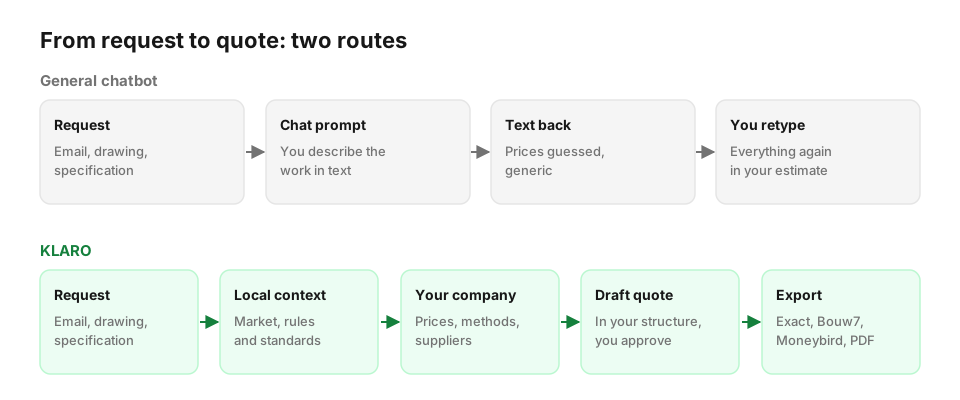
Yes and no. Ask ChatGPT or Claude for a quote for "an 8 m² bathroom renovation" and within ten seconds you get a tidy overview with line items and amounts. The problem is the amounts: they don't come from your company. The model doesn't know your prices, which suppliers you work with, or a single project you have done. It gives an average estimate that looks convincing.
For a contractor that is worse than no answer. A quote 15% too low costs you margin. A quote 15% too high costs you the job. And because the numbers are neatly formatted, the error only shows when you check everything, at which point you could have built the estimate yourself.
What general AI is good at: writing a cover email, summarising a long specification, explaining a client question or polishing your text. Use it for that. For the estimate itself you need something else.
Why do general AI models fall short on construction quotes?
It is not about model quality. ChatGPT, Claude and Gemini are among the best software ever built. They are built to talk about everything, not to know construction or your company. On quotes they hit five limits.
1. They don't know your prices
A good quote starts from your own prices: your labour rate, what you pay your suppliers, your markups for overheads, profit and risk. Those are not on the internet. A general model has to guess, and it guesses with full confidence.
2. They lack local construction context
Cost codes such as STABU, reverse-charge VAT, the right units, overheads, regulations and the standards your client expects: a general model knows them superficially at best and doesn't apply them consistently.
3. Arithmetic is not their strong suit
Language models predict words. Making an estimate with hundreds of lines, quantities and markups add up without errors is a different job. One wrong quantity flows into the total, and on large estimates lines can quietly go missing.
4. They forget your corrections
Correct a price in ChatGPT and it is gone in the next conversation. A chatbot remembers loose facts at best, not how you price and build up your work.
5. The output is text, not a quote
What you get back is a block of text or a table in a chat window, which you still retype into your own system. And on consumer chatbot plans, what you enter may be used to improve models depending on your settings, which is not where you want client data and prices.
What does AI need to produce a usable construction quote?
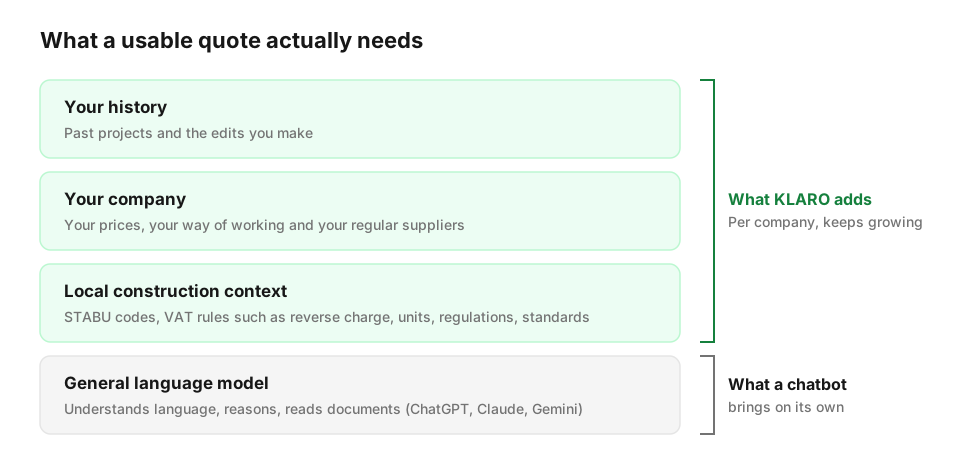
A usable quote needs four layers of knowledge. A general language model only supplies the bottom one: understanding language, reasoning and reading documents. The three layers above it are specific to construction and to your company.
- Local construction context: cost codes such as STABU, VAT rules such as reverse charge, units, regulations and standards.
- Your company: your prices, your way of working and your regular suppliers.
- Your history: past projects and the edits you make.
What makes KLARO different?
KLARO is a refined AI model for construction. It understands a request as well as a general assistant does, but works with the context such an assistant lacks.
| ChatGPT, Claude or Gemini (on its own) | KLARO | |
|---|---|---|
| Prices | Estimated from general knowledge | From your own company data |
| Construction context | Generic, not market-specific | Local market, VAT rules, STABU and standards |
| Suppliers | Unknown | Your regular suppliers |
| Structure | Text or a table in a chat | Quote with chapters, line items and cost codes |
| Your corrections | Forgotten after the conversation | KLARO learns from them, you decide what it adopts |
| Output | Retype into your own system | On to Exact, Bouw7, Moneybird or PDF |
| Your data | May be used for training, depending on settings | Never used to train AI models, stored in the EU |
| Sending | You copy and paste | Nothing goes out without your approval |
Built for your construction market
KLARO knows the market you work in. In the Netherlands that means STABU, reverse-charge VAT, common units, regulations and the standards clients expect.
Your company as the starting point
KLARO works from your own company data: your prices, your way of working and your relationships with your regular suppliers. So the quote looks like one you would write yourself, not an average of the internet.
A quote in your structure
You don't get chat text but a quote with chapters, line items and cost codes that you can edit straight away and pass on to Exact, Bouw7 or Moneybird.
You stay in control
Every quote is a draft. Nothing goes out without your approval.
How does KLARO learn from your projects?
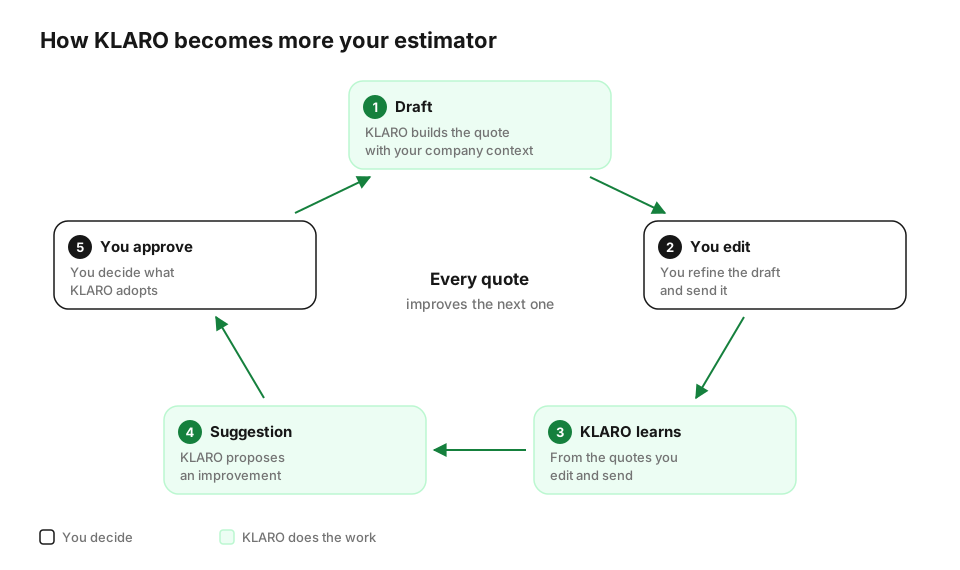
This is the biggest difference from a chatbot. Every quote you edit and send makes KLARO better. KLARO picks up how you price and build up your work, and suggests improvements. You decide what KLARO adopts.
So with every project KLARO becomes a little more your estimator, instead of an average of the internet. What KLARO learns from you stays inside your own account: it is not shared with other companies and not used to train general AI models.
Which construction office work can AI handle today?
Quotes take the most time, but they are not the only job. With a specialised system you can already automate:
- Quotes and estimates from an email, briefing, drawing or specification.
- Email triage: spotting requests, scoring leads and preparing draft replies in Outlook.
- Materials: preparing orders with your regular suppliers.
- Hand-off to your books: on to Exact, Bouw7 or Moneybird.
For more examples, see our practical guide to AI for contractors.
How to get started
You don't have to choose between ChatGPT and KLARO: use a general assistant for writing, and a specialised model for your estimate. Getting started with KLARO takes about fifteen minutes and we help you personally. Let KLARO work out the next request, compare the draft with how you would do it and refine what's off. That is what KLARO learns from.
You can try KLARO free for 14 days. To see how we handle your data first, read the Trust Center.
Frequently asked questions
Can I use ChatGPT to write construction quotes?
For text, yes: a cover email or a summary of the specification. For the estimate, no: ChatGPT doesn't know your prices, your suppliers or your local construction context, and estimates missing amounts. Check every amount a general chatbot gives you.
What is the difference between KLARO and ChatGPT or Claude?
KLARO is a refined AI model for construction. It has the context of the local market, VAT rules and standards such as STABU, and works from your own company data and your regular suppliers. Quotes get your structure and pass on to Exact, Bouw7 or Moneybird. And KLARO learns from your edits.
Does KLARO have its own AI model?
KLARO works with an AI model refined for construction and given the context general models lack: the local construction market, regulations and standards, and the data of your own company.
Does KLARO learn from my edits?
Yes, but only for your own organisation. KLARO learns like a junior colleague who joins your company: from the quotes you edit and send, within your way of working. What KLARO learns with you is never used for other organisations, and KLARO doesn't bring other companies' ways of working into your quotes. KLARO suggests improvements; you decide what it adopts.
Is my data used to train AI?
No. Your data is never used to train AI models. It is stored in the EU (Ireland) and encrypted. What KLARO learns from you stays inside your own account.
Does KLARO send quotes to clients by itself?
No. Every quote, email and order is a draft. Nothing goes out without your approval.